

Client Profile
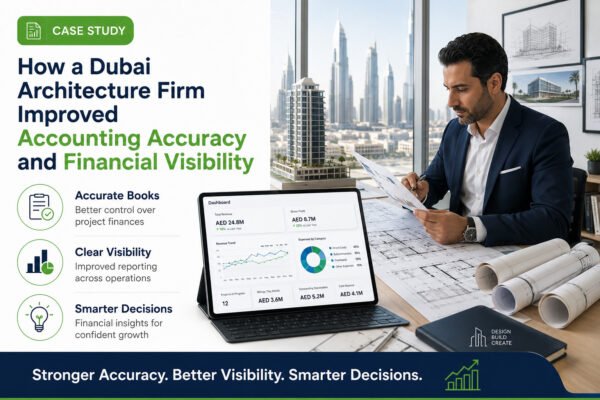
A leading architecture and interior firm based in Dubai that handles complete end-to-end fit-out projects, from conceptualization and in-house production to execution and final delivery.
The firm works on both commercial and residential large-scale projects, managing material purchases, internal transactions, inventory management, and revenue recording based on the progress of the project.
Core Challenges They Faced
When the company approached us, they were facing significant financial and operational challenges.
Financial and Accounting Challenges
- Previous years’ accounts were not closed properly, which resulted in delays in the audits.
- The accounting treatments were applied incorrectly over the years. Expenses were misclassified, and revenue was incorrectly recognized.
- Important accounting items like amortisation, accruals, prepaid expenses, and provisions were not handled properly.
- Bank reconciliations were incomplete and pending for a long time.
- Customer and supplier balances were unreliable, with no proper tracking or confirmation.
- Transactions between companies were not structured properly, which resulted in mismatched balances.
- Implications of transfer pricing were not properly considered, followed, or documented.
- Fixed assets were not properly classified or depreciated.
- There was no proper monthly closing process or reporting system.
Operational and Process Challenges
- The finance team didn’t fully understand how the business model, especially the long-term fit-out projects, affected accounting treatment.
- The documentation was poorly managed, with no proper folder structure and no clear system for managing the files digitally.
- Important documents like purchase orders, delivery notes, GRNs, and supplier invoices were not properly matched and managed.
- The mismatch between the records and the actual physical stock led to major inventory discrepancies.
- There was no proper coordination between the procurement and accounts departments.
- No clear standard operating procedures (SOPs) for handling documentation, approvals, or financial checks.
- There were no proper systems to get a full project-level financial analysis.
- The management team lacked access to accurate and up-to-date financial reports for decision-making.
While the company was growing operationally, the finances and accounts were lacking structure, visibility, and control.
How We Helped?
When our services were engaged, we ensured to use a hands-on, strategic, and structured approach to help their transformation.
Step 1: On-Site Diagnostic and Process Mapping
To get a better understanding of their end-to-end operations, we decided to start by conducting detailed on-site visits. We looked into every step of their process, from procurement and manufacturing to execution and final billing. After understanding their processes, we started identifying the loopholes. This included any accounting problem or operational weakness.
Once we understood the process and found the loopholes, our goal was clear. We started mapping out the operational workflows that would help us account for the final impact.
Step 2: Financial Clean-Up and Historical Reconstruction
Our next step was to work on the weaknesses and loopholes we found. To do that, we started reconstructing and reconciling previous years’ accounts. We corrected the accounting errors made over the years and then properly implemented the treatment of project costing, accruals, prepayments, amortisation, depreciation, and revenue recognition.
We also reconciled the bank, customer, and supplier balances. Then we reviewed and fixed the transactions between group companies to ensure that the balances match across entities. We also implemented proper transfer pricing adjustments wherever required.
By doing this, we were able to reconcile all accounts from previous years and organize the records that were audit-ready within 3-4 months.
Step 3: Process and Control Implementation
We moved forward with creating an organized system to store documents digitally. These standard folders provided easy access and made tracking easy. Then, we moved forward with defining SOPs for procurement, invoice processing, and approvals.
We even set up a structured monthly closing schedule and reporting framework, and introduced regular reconciliation processes for bank accounts, inter-company transactions, inventory records, customer and supplier balances.
Step 4: Inventory and Procurement Alignment
We collaborated with the procurement team to accurately match the purchase orders, delivery notes, supplier invoices, and ensure the GRNs were processed correctly. We performed detailed item-by-item stock checks and adjusted stock valuations to reflect the correct inventory values. This minimized the differences between recorded inventory and the actual stock.
Step 5: Team Training and Knowledge Transfer
Our focus was not just on correcting the past errors, but on creating a lasting financial discipline. We trained their internal team on core accounting principles tailored to the company’s business model. We guided them on how to organize their documents and submit their data promptly.
Lastly, we set up structured protocols for sharing data online to improve transparency and clarified the roles and communication between operations and finance teams to ensure a smoother workflow.
Outcomes and Results Achieved
Within months, the firm could see visible financial improvements and operational impact
Financial Improvements
- All previous years’ accounts were fully reconciled and prepared for audit.
- Started generating reliable and accurate monthly financial reports
- The customer and supplier balances are now fully tracked with up-to-date ageing reports.
- Inter-company transactions are now properly recorded and balanced.
- Transfer pricing is now correctly documented to meet compliance requirements.
- Inventory is accurately valued and reflected in the financial statements.
- The firm’s overall compliance has improved, which has in turn reduced the risk of issues during audits.
Operational Impact
- Management now has real-time insights into the profitability of each project.
- Documents are being organized systematically on a regular basis.
- Procurement and finance teams have started working together seamlessly.
- Financial errors and potential leakages have been minimized.
- The monthly closing process has become faster and more efficient.
- With reliable data, the management has been able to make informed decisions.
Strategic Value
With our clear processes, standardized documentations, and consistent reporting, the company successfully transitioned to a structured and disciplined system of financial governance. As a result, the business now enjoys sustainable growth, greater confidence in compliance with regulations, and improved operational efficiency across all departments.
Conclusion
What began as a financial clean-up management evolved into a complete financial transformation. Today, the client benefits from the controlled processes we developed and our transparent reporting systems. We provided them with systematic inter-company accounting, accurate inventory management, and helped create and train a finance team that is fully aligned with their business operations.
At A2R Info Solutions, we turned their complex and unstable processes into a clear and reliable framework, which helped them make informed decisions and drive sustainable growth.