

As businesses grow, management can become complex and ultimately overwhelming. Increased transactions, pending finances, and mishandled records don’t just pile up errors, but compound them over time. Not all businesses need a full finance team, but someone who can own their numbers and bring financial clarity. A specialist, specifically a full-charge bookkeeper, is a bookkeeping expert who can help businesses accurately record and manage their finances.
Let’s understand everything about full charge bookkeeping services, including what they do, types of bookkeeping services, how to understand if your business needs one, and what factors to consider while hiring.
Understanding Full Charge Bookkeeping
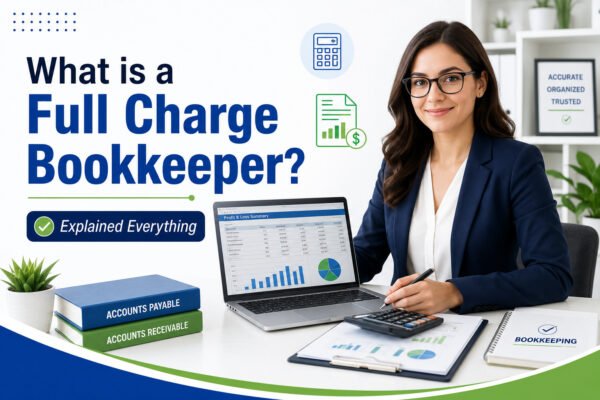
Full-charge bookkeeping is a financial management service that takes full ownership of a business’s bookkeeping cycle. A full charge bookkeeper records transactions, categorises them, reconciles accounts, and generates reports to maintain the financial story of a business from initial entries through final reports.
A full charge bookkeeper’s role goes beyond just basic bookkeeping duties like data entry. They take responsibility for maintaining complete and accurate financial records, handling the entire bookkeeping process until higher-level accounting or tax filing begins.
What a Full Charge Bookkeeper Does: Key Duties and Responsibilities
A full-charge bookkeeper works closely with the business owner, accountant, and other departments to make sure all financial records are in order.
These are the main duties and responsibilities of a full-charge bookkeeper:
Day-to-day | Monthly | Yearly |
Recording all transactions (sales, expenses, payroll) | Reconciling bank & credit card statements | Preparing financial statements (including balance sheets & income statements) |
Maintaining the general ledger and supporting documents | Checking outstanding invoices | Organising records for tax filing and supporting tax preparation |
Categorising transactions properly | Preparing financial statements (including balance sheets, P&L, and cash flow summaries) | Reviewing year-end adjustments |
Issuing invoices | Reviewing accounts payable and receivable | Ensuring compliance with financial regulations |
Tracking incoming payments and processing outgoing payments | Identifying discrepancies or unusual entries | Supporting audits or annual compliance reviews, where required |
Managing expense entries | Reviewing payroll records and recurring expense entries | Ensuring financial records are complete and properly archived |
Other duties can include:
- Assisting in budgeting and basic financial forecasting,
- Tracking inventory records & ensuring alignment with financial data (where applicable),
- Preparing and organising financial records for audits and to meet compliance requirements,
- Advise junior bookkeeping or accounting staff in larger teams,
- Communicating financial information to business owners or management.
Skills and Education
A full charge bookkeeper needs to handle a broad and demanding set of responsibilities, and is expected to have a solid mix of technical knowledge and skills. So, if you want to hire a full charge bookkeeper, here are the qualifications, certifications, and requirements to generally look out for.
1. Educational Background
Most full charge bookkeepers have a formal education in accounting, finance, or business. Common qualifications you can look out for include:
- Bachelor’s degree in Accounting, Finance, or Business Administration.
- Associate Degree or equivalent coursework in accounting or bookkeeping.
The other alternative pathways are:
- Accounting or finance diplomas
- Short-term certification programs in bookkeeping or accounting.
Note that while most full-charge bookkeepers possess formal degrees like these, practical accounting knowledge matters more.
2. Certifications
Certifications play a big role in getting hired as a full-charge bookkeeper. While NOT ALWAYS REQUIRED, having one or more of the basic and high-level accounting certifications shows credibility, knowledge, and helps build a stronger profile.
3. Knowledge & Skills
Because full charge bookkeeping deals with sensitive financial data and needs a high level of accuracy, you need the following qualities in a full charge bookkeeper:
- A good grasp of accounting fundamentals (entries, ledgers, trial balance, etc.)
- Financial reporting skills (P&L statements, balance sheets, cash flow summaries)
- Knowledge of tax regulations and compliance requirements (such as sales tax, VAT, etc., depending on the region)
- Software expertise (QuickBooks, Xero, Sage, etc.)
- Key soft skills (attention to detail, organisation, analytical thinking, time management, and communication)
4. Experience
There are three levels of experience expectations for a full charge bookkeeper.
Entry-level | 0–2 years (basic bookkeeping) |
Mid-level | 2–5 years (handles full cycle) |
Experienced | 6+ years (in full charge bookkeeping or equivalent role managing full-cycle accounting) |
Note: Practical exposure, along with proven skills, matters more than theoretical knowledge alone.
Salary Expectations
A full charge bookkeeper’s salary can vary depending on multiple factors like location, industry, level of experience and education, and the complexity of responsibilities.
In general, a full charge bookkeeper can expect to earn a moderate to high salary within the accounting and finance function. Higher compensation is typically offered to those who manage end-to-end bookkeeping, financial reporting, and compliance tasks independently.
Key Differences Between Full Charge Bookkeeper, Bookkeeper & Accountant
A bookkeeper, an accountant, and a full charge bookkeeper are different roles, with distinct duties, levels of responsibility, and ranges of work. Let’s take a look at what differentiates them from each other.
Bookkeeper | Records data |
Full Charge Bookkeeper | Manages full cycle |
Accountant | Analyzes and advises |
Bookkeeper vs Full Charge Bookkeeper
A bookkeeper records financial transactions, and a full-charge bookkeeper is required to manage the entire bookkeeping process and reporting.
In simple terms, a bookkeeper takes care of data entry, and a full charge bookkeeper takes ownership of the data and reports.
Full Charge Bookkeeper vs Accountant
A full charge bookkeeper generally coordinates with the organisation’s accountant, making both roles complementary to each other.
While a full charge bookkeeper maintains and prepares independent and end-to-end accuracy of records, an accountant is generally expected to interpret and strategize accordingly.
When Does a Business Need a Full Charge Bookkeeper?
So how do you decide which accounting expert you need? What kind of businesses can benefit from hiring a full charge bookkeeper? Does your business need one yet? Let’s break it down.
Situations that need a full charge bookkeeper:
- Scaling business
- Increasing revenue
- Multiple income streams
- Inconsistent records, missed payments, and delayed collections
- Preparing for funding/audits
So when finances move from manageable to overwhelming and guesswork just won’t do it anymore, your business needs a full charge bookkeeper to maintain or regain financial control.
How to Choose the Right Bookkeeping Service?
Once you decide that you need a full charge bookkeeper, it all comes down to the important factors that fall in line with your business needs. Let’s figure out the things to spot and questions to ask while choosing the right bookkeeping service for you.
Factors that help decide the right bookkeeping professional or service:
- Experience in a similar industry
- Expertise in software that matches your system
- Accuracy and reliability based on track record
- Ability to handle sensitive data properly for data security
- Solutions for scaling businesses
- Communication skills
- Punctuality for regular reports and update clarity
Landing on the right bookkeeping service is not just about understanding the experience and skills; you need to evaluate your business’s needs, both now and in the future. For businesses looking for more consistent or full-time bookkeeping support, a structured partner such as A2R Info Solutions can be worth considering.
Conclusion
The truth is, a full charge bookkeeper tracks your current finances and helps businesses achieve stability. Accurate records and well-managed finances are the base of financial health, and the right bookkeeper will give way to financial clarity, well-informed decisions, and stable growth with the future in mind.
Frequently Asked Questions
What does full charge bookkeeping include?
Full charge bookkeeping includes the complete bookkeeping cycle of a business. This includes recording all transactions, reconciling statements, preparing financial statements, maintaining the general ledger, reviewing adjustments, issuing invoices, and ensuring accuracy. It also includes compliance with financial regulations and organising records for tax filing.
Can a full charge bookkeeper handle payroll?
Yes, many full charge bookkeepers handle payroll, depending on the business’s needs. This can include salaries, employee records, deductions, and compliance with regulations.
Do small businesses need a full charge bookkeeper?
Even small and growing businesses can benefit from hiring a full charge bookkeeper for better organisation, accuracy, and visibility. To figure out if your small business needs a full charge bookkeeper, check the complexity of your finances.
What software does a full charge bookkeeper typically use?
Accounting tools like Excel, Zoho Books, QuickBooks, or Xero. Software can depend on the size of the business, its location, and specific needs.
Can full charge bookkeeping be outsourced?
Yes, you can outsource a full charge bookkeeping service. Outsourcing can be a great option for small to mid-sized businesses because it’s cost-effective and easy to manage. But, it’s important to note that you might have less direct control over day-to-day work, and communication might take more effort. To decide on outsourcing vs hiring full-time, check your business’s priority: active control vs flexibility and cost savings.