

Let’s be honest, businesses today have to deal with a lot of pressure to manage their money correctly and keep their costs low. With rising growth, taking care of accounting tasks becomes more complicated. This means they need to do reports on time, manage payroll, balance their books and make smart plans for their money.
This puts business owners in a spot where they often need to decide whether they should create a whole accounting team in their company or pay someone else to do all their accounting work?
Hybrid accounting can make things simpler for you.
It is really useful because it lets the people be in charge of money inside a company and get help from experts outside the company, at the same time.
This way the company can still make decisions but they can give routine jobs to people who are experts at them and use special software and resources that can grow with the company.
This helps the company do better save money and make reports that’re more accurate. It also helps the people in charge of money inside the company focus on things that will help the company grow.
So if you want your company to run well no matter how big or small it is you need to know what hybrid accounting is and if it is right for you.
Hybrid accounting can be good for any kind of company whether you have a business, a big company that works in many countries or if you work with an accounting agency. You should learn about accounting to see if it is the best choice for your company and how it can help your hybrid accounting needs.
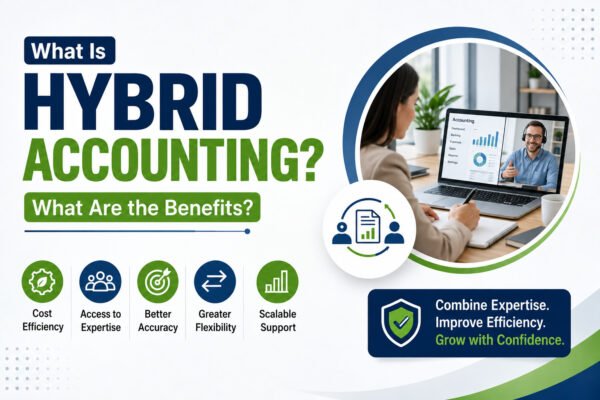
What Is Hybrid Accounting?
An operating model in which a business manages selected accounting activities internally while outsourcing other accounting functions to an external accounting service provider is hybrid accounting. Rather than choosing between a fully in-house or fully outsourced finance department, businesses create an approach that works best for their operational needs by integrating elements of both.
The division of labor is different for each business and is based on a number of factors, including the following:
- Complexity: Accounting tasks that involve a lot of specialization and/or industry-specific expertise may require more experienced personnel.
- Internal Capacity: Tasks that a company’s internal team has limited time or capability to execute can be outsourced.
- Volume: High volumes of invoice processing or bookkeeping are good candidates for outsourcing.
- Compliance: Outsourced financial functions can include regulatory reporting, payroll and tax compliance.
- Confidentiality: Financial decisions and executive reporting are typically kept internal.
- Reporting: Organizations have the option of outsourcing the preparation of reports and maintaining the review and interpretation of the reports.
Rather than replacing the internal finance department, a hybrid accounting approach builds upon the internal team with external specialists who perform routine accounting tasks, freeing internal team members to perform the higher level functions of financial management.
Example of a Hybrid Accounting Model
A common hybrid accounting structure involves dividing responsibilities between the internal finance team and an outsourced accounting partner.
The business may retain the following functions internally:
- Financial approvals
- Budget planning
- Cash-flow management
- Strategic financial decision-making
- Executive reporting
Meanwhile, an outsourced accounting provider may manage:
- Bookkeeping
- Invoice processing
- Accounts payable
- Accounts receivable
- Bank reconciliations
- Payroll processing
- Management reporting
For example,a manufacturing firm may have an internal finance manager who approves vendor payments, runs budgets, and articulates financial performance to the management team, while they outsource accounting activities such as recording daily transactions, clearing accounting, coding, and taking care of payroll and reporting to an outsourced accounting team. Here, the firm has finance under its control while having support from specialized accounting services.
How Does Hybrid Accounting Work?
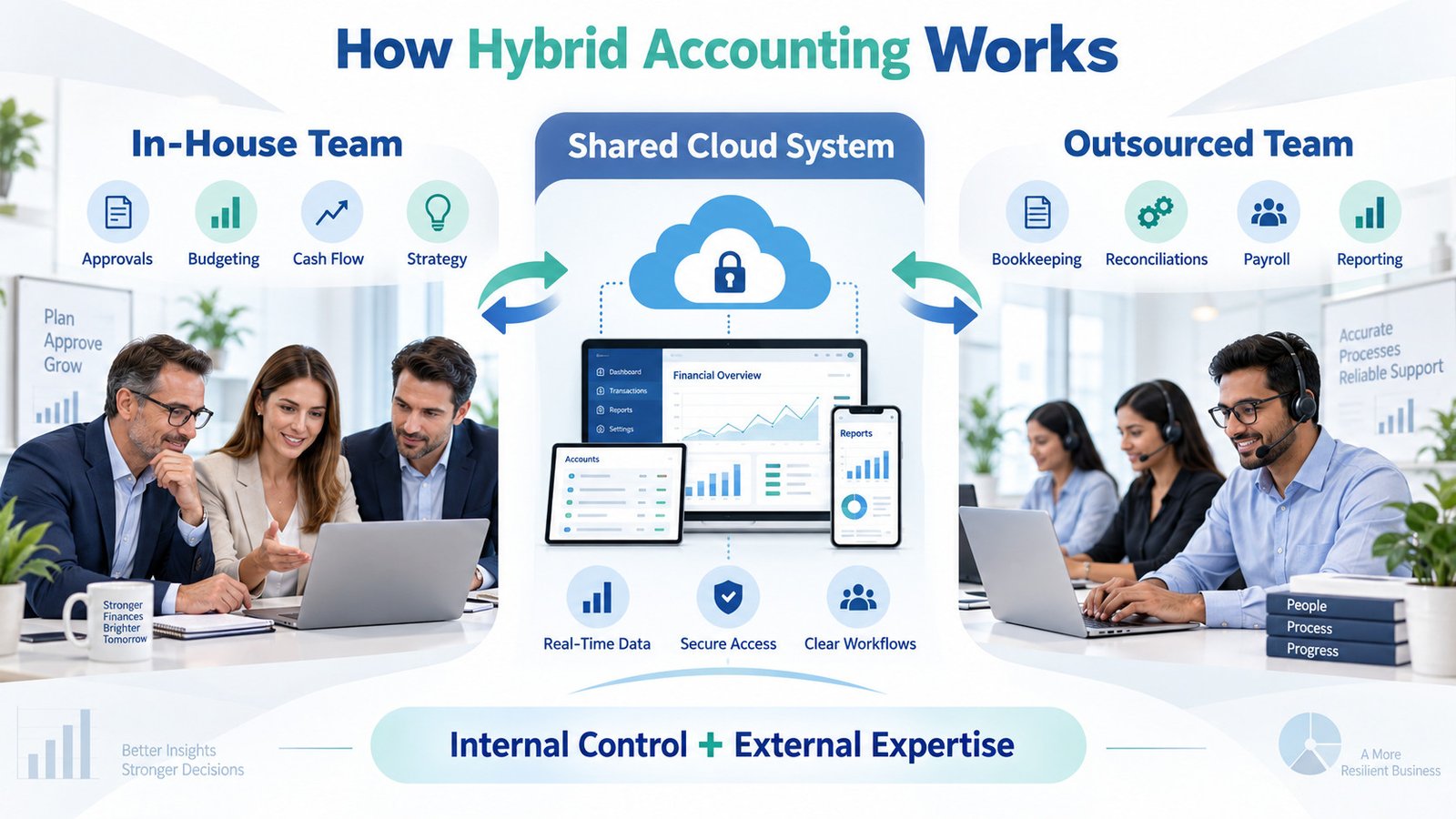
Hybrid accounting combines the internal finance team with a third-party accounting service provider and works best when teams have well-defined roles and use common cloud-based accounting software, automated workflows, and repetitive reporting systems.
The hybrid model thrives on structure and visibility. Functions are assigned to the teams best suited to perform them. This eliminates overlapping tasks and removes potential ambiguity regarding ownership.
For example, although the outsourced provider will process supplier payments, the internal finance manager would review and approve supplier payments prior to payment being released. The outsourced accounting team may also prepare monthly financial statements, which the management team would use to make business assessments and decisions.
This balance of operational effectiveness and financial control is what makes the model work.
Role of the In-House Accounting Team
Although a lot of work is outsourced, the people who handle the money inside the company still have a big job to accomplish. They help decide where the money goes and how it is spent. Their role is key to keeping everything running smoothly.
Typical responsibilities include:
- Financial approvals
- Cash-flow planning and monitoring
- Budget preparation and financial forecasting
- Vendor relationship management
- Communication with senior management
- Handling confidential financial information
- Strategic decision-making
- Business performance analysis
Role of the Outsourced Accounting Team
The outsourced accounting provider focuses primarily on executing day-to-day accounting processes accurately and efficiently.
Common responsibilities include:
- Daily bookkeeping
- Recording financial transactions
- Accounts payable processing
- Accounts receivable management
- Bank and account reconciliations
- Invoice processing
- Payroll support
- Month-end closing activities
- Preparation of financial reports
- Management reporting
Because outsourced accounting firms often serve businesses across multiple industries, they bring specialized expertise, standardized processes, and exposure to a wide range of accounting systems and compliance requirements.
This allows businesses to improve accounting accuracy while reducing the administrative burden on their internal finance teams.
Technology Used in Hybrid Accounting
Technology plays a central role in the success of hybrid accounting. Most businesses adopting this model rely on cloud-based accounting platforms that enable both internal and outsourced teams to work from the same financial data in real time.
Some of the most widely used accounting software solutions include:
- QuickBooks
- Xero
- Zoho Books
- NetSuite
- Odoo
- SAP Business One
Cloud accounting software provides several advantages over traditional desktop systems. It allows authorized users to securely access financial information from any location, reducing delays caused by file sharing or manual data transfers.
Additional benefits include:
- Real-time financial visibility
- Automated bank feeds
- Secure document storage
- Role-based user permissions
- Automated reconciliations
- Integrated approval workflows
- Faster financial reporting
- Improved collaboration between teams
By working within a shared accounting environment, businesses and outsourced accounting partners can collaborate more efficiently while maintaining strong internal controls and data security.
Hybrid Accounting vs In-House Accounting
Both hybrid accounting and traditional in-house accounting offer unique advantages. However, they differ significantly in terms of cost structure, scalability, expertise, and resource management.
| Factor | Hybrid Accounting | In-House Accounting |
| Team structure | Combination of internal and outsourced accounting professionals | Fully internal accounting department |
| Cost | Flexible and scalable with lower fixed costs | Higher fixed employment, infrastructure, and training costs |
| Expertise | Access to broader accounting knowledge and specialized skills | Limited to the experience of internal employees |
| Scalability | Easy to increase or decrease support as business needs change | Requires additional recruitment and onboarding |
| Control | Shared control with clearly defined approval workflows | Primarily managed internally |
| Technology | Typically uses cloud-based accounting platforms with collaborative access | Depends on existing internal systems and technology investments |
Businesses with predictable accounting workloads and large internal finance departments may prefer an entirely in-house model. However, organizations seeking greater flexibility, cost optimization, and access to specialized expertise often find hybrid accounting to be a more practical solution.
Hybrid Accounting vs Fully Outsourced Accounting
Hybrid and fully outsourced accounting both use external accountants. However, the degree and nature of oversight and engagement of internal accounting staff differ.
With fully outsourced accounting, the majority or all of an organization’s accounting functions are rendered to an external service provider. External service providers can perform nearly all the functions of accounting, including bookkeeping, payroll services, accounts payable, accounts receivable, reconciliation, and reporting, as well as providing accounting services at controller and CFO level. Many organizations with this approach have no internal accounting staff and outsource the management of their accounting function.
In a hybrid accounting model, responsibilities are split between the internal team and the provider. In this model, some accounting functions are outsourced to external parties, while a client’s staff has control over important financial activities like budgeting, payment approvals, cash management, finance and banking relationships, financial oversight, and corporate strategy.
In situations where both control and flexibility are of the utmost concern, hybrid accounting models are the preferred model. This model supports a collaborative approach to accounting and greater flexibility in adapting as the internal team grows or business requirements change.
Key Benefits of Hybrid Accounting
Hybrid accounting has become a popular model because it combines operational efficiency with financial oversight. By dividing accounting responsibilities between internal teams and outsourced professionals businesses can optimize costs, improve reporting accuracy and gain access to specialized expertise without compromising control.
Lower Accounting Costs
Building and maintaining an in-house accounting department involves more than salaries. Businesses must also account for recruitment costs, employee benefits, training, office infrastructure, software licensing and ongoing professional development.
Hybrid accounting helps reduce many of these fixed expenses by outsourcing accounting functions while retaining only essential financial roles internally. Instead of hiring multiple full-time employees businesses can access experienced accounting professionals as needed making the model significantly more cost-effective, particularly for small and medium-sized businesses.
Access to Experienced Accountants
Accounting regulations, reporting standards, and financial technologies continue to evolve. Keeping an internal team updated on every change can be challenging and expensive.
With hybrid accounting, businesses gain access to professionals experienced in:
- Bookkeeping
- Financial reporting
- Payroll proc0essing
- Tax compliance support
- Accounts payable and receivable
- Bank reconciliations
- Various accounting software platforms
Many outsourced accounting providers work with clients across multiple industries, giving them exposure to best practices that can improve operational efficiency and reporting accuracy.
Greater Financial Control
Unlike a fully outsourced model, hybrid accounting allows management to retain authority over critical financial decisions.
Businesses can continue to oversee:
- Payment approvals
- Budget planning
- Cash-flow management
- Financial forecasting
- Investment decisions
- Executive reporting
Routine accounting work is delegated externally, while strategic decision-making remains within the organization. This balance helps businesses maintain accountability while benefiting from professional accounting support.
Flexible and Scalable Support
Business needs rarely stay constant. Seasonal demand, rapid growth, acquisitions, or expansion into new markets can significantly increase accounting workloads.
Hybrid accounting allows organizations to scale accounting support up or down without lengthy recruitment processes. Additional bookkeeping, reconciliations, payroll support, or reporting assistance can be introduced when transaction volumes increase and reduced during quieter periods.
This flexibility enables businesses to respond more effectively to changing operational requirements.
Faster Financial Reporting
Delayed financial reports can slow down decision-making and reduce visibility into business performance.
Hybrid accounting improves reporting efficiency through:
- Clearly defined workflows
- Dedicated accounting specialists
- Automated accounting software
- Regular reconciliation schedules
- Standardized month-end procedures
With routine accounting tasks handled consistently, businesses are often able to complete month-end closing and management reporting more quickly, providing leadership with timely financial insights.
Reduced Workload for Internal Teams
Internal finance professionals frequently spend considerable time on repetitive administrative work such as transaction recording, invoice processing, and reconciliations.
By outsourcing these operational activities, internal teams can focus on higher-value responsibilities including:
- Financial analysis
- Business planning
- Strategic decision-making
- Performance monitoring
- Risk management
- Process improvement
This shift allows finance departments to contribute more directly to business growth rather than being consumed by routine accounting tasks.
Improved Process Continuity
Many businesses rely heavily on one or two key finance employees. If those individuals take leave, resign, or become unavailable, accounting operations may be disrupted.
An outsourced accounting partner typically operates with documented procedures, multiple team members, and standardized review processes. This reduces dependency on any single individual and helps maintain continuity during employee absences, staff turnover, or periods of rapid expansion.
Access to Better Accounting Technology
Hybrid accounting providers often work with modern cloud-based accounting systems and automation tools that many businesses may not have implemented internally.
These technologies can include:
- Automated bookkeeping workflows
- Digital document management
- Financial dashboards
- Approval workflows
- Bank integrations
- Automated reconciliation tools
- Secure cloud storage
Access to advanced accounting technology improves collaboration, reduces manual work, and enhances the accuracy of financial information.
Challenges of Hybrid Accounting
While hybrid accounting offers numerous advantages, its success depends on careful planning, clear communication, and effective collaboration between internal and outsourced teams.
Unclear Division of Responsibilities
One of the most common challenges arises when responsibilities are not clearly defined.
Without documented ownership of each accounting process, businesses may experience:
- Duplicate work
- Missed deadlines
- Incomplete records
- Approval delays
- Reporting errors
Creating a responsibility matrix helps ensure every accounting activity has a designated owner.
Communication Gaps
Hybrid accounting requires regular communication between both teams.
Poor communication can affect:
- Reporting timelines
- Vendor payments
- Payroll processing
- Month-end closing
- Approval workflows
Regular meetings, shared dashboards, and standardized reporting schedules help maintain alignment and prevent misunderstandings.
Data Security Concerns
Financial information is among a company’s most sensitive business data.
When working with an outsourced accounting provider, businesses should ensure appropriate measures are in place, including:
- Role-based access controls
- Secure cloud platforms
- Confidentiality agreements
- Data encryption
- Multi-factor authentication
- Employee security policies
Evaluating these safeguards before selecting an accounting partner is essential.
System Integration Issues
Using different accounting software, reporting formats, or document management systems can create unnecessary inefficiencies.
To avoid integration challenges, businesses should ensure both teams work with compatible systems and standardized processes whenever possible.
Dependence on the Right Outsourcing Partner
The effectiveness of hybrid accounting depends heavily on the quality of the outsourced provider.
An experienced accounting partner should demonstrate:
- Strong technical expertise
- Reliable communication
- Consistent quality control
- Industry knowledge
- Transparent reporting
- Scalable support
Choosing the wrong provider may result in delays, inaccuracies, or compliance risks.
Which Accounting Functions Can Be Outsourced?
Hybrid accounting allows businesses to outsource a wide range of operational accounting activities while retaining strategic financial oversight internally.
Commonly outsourced functions include:
- Bookkeeping
- Accounts payable
- Accounts receivable
- Invoice processing
- Bank reconciliation
- Credit card reconciliation
- Payroll processing
- Catch-up bookkeeping
- Financial reporting
- MIS reporting
- Budgeting and forecasting support
- Month-end closing assistance
The specific combination of outsourced services depends on the organization’s size, transaction volume, internal expertise, and reporting requirements.
Who Should Use a Hybrid Accounting Model?
Hybrid accounting is suitable for businesses across different industries and stages of growth.
Small and Growing Businesses
Small businesses often need professional accounting support but may not have the resources to build a complete finance department.
Hybrid accounting provides access to experienced professionals while keeping costs manageable.
Companies With Small Internal Finance Teams
Organizations with a finance manager or a small accounting team may require additional support during busy reporting periods or as transaction volumes increase.
Outsourcing operational accounting tasks allows internal staff to focus on strategic financial management.
Businesses Expanding Internationally
International expansion introduces additional accounting complexities such as:
- Multiple currencies
- Different tax regulations
- Diverse reporting requirements
- Cross-border transactions
Hybrid accounting enables businesses to access specialized expertise while maintaining centralized financial oversight.
Businesses With Seasonal Transaction Volumes
Retailers, hospitality businesses, manufacturers, and e-commerce companies often experience seasonal increases in accounting activity.
Temporary outsourced support helps manage additional workloads without permanent hiring.
Accounting and CPA Firms
Many accounting and CPA firms adopt hybrid accounting by outsourcing bookkeeping, reconciliations, payroll processing, and financial reporting while retaining client relationships, advisory services, and final review responsibilities internally.
This approach improves capacity, increases efficiency, and supports business growth.
How to Build an Effective Hybrid Accounting Team
Successfully implementing hybrid accounting requires more than outsourcing selected tasks. It involves establishing clear processes, responsibilities, and communication channels that allow both teams to work together efficiently.
Define Roles and Responsibilities
Develop a responsibility matrix outlining who is responsible for every accounting activity.
Clearly assigning ownership minimizes confusion and improves accountability.
Establish Approval Workflows
Define who is responsible for preparing, reviewing, approving, and releasing financial transactions.
Well-designed approval workflows strengthen internal controls and reduce operational risks.
Use a Shared Accounting System
Both internal and outsourced teams should work within compatible cloud-based accounting software and document-sharing platforms.
A shared system ensures everyone has access to current financial information while maintaining appropriate security controls.
Set Reporting Timelines
Establish clear expectations for daily, weekly, monthly, and year-end deliverables.
Consistent reporting schedules improve planning and ensure financial information is available when needed.
Maintain Review Controls
Strong review processes improve accounting accuracy.
Businesses should implement:
- Maker-checker controls
- Reconciliation reviews
- Approval checkpoints
- Month-end closing checklists
- Exception reporting
These controls help identify and resolve discrepancies before financial reports are finalized.
Conduct Regular Performance Reviews
Hybrid accounting should be continuously monitored and refined.
Performance reviews may evaluate:
- Accuracy
- Turnaround time
- Outstanding issues
- Reporting quality
- Compliance
- Opportunities for process improvement
Regular feedback helps strengthen collaboration and supports continuous operational improvement.
How to Choose a Hybrid Accounting Partner
Selecting the right outsourcing partner is one of the most important decisions when implementing a hybrid accounting model. While the internal team retains financial oversight, the external provider becomes responsible for critical day-to-day accounting activities. Their expertise, processes, and reliability can directly influence the accuracy of financial records and the efficiency of accounting operations.
When evaluating a hybrid accounting partner, businesses should consider the following factors:
- Industry Experience: Look for a provider with experience working in your industry. Familiarity with industry-specific accounting practices, reporting requirements, and operational challenges can reduce onboarding time and improve service quality.
- Knowledge of Accounting Standards: Ensure the provider understands the relevant accounting standards and compliance requirements applicable to your business, whether local or international.
- Software Expertise: Verify that the accounting team has hands-on experience with the accounting platforms your business uses, such as QuickBooks, Xero, Zoho Books, NetSuite, Odoo, or SAP Business One.
- Data Security Procedures: Financial information is highly confidential. Assess the provider’s approach to data protection, including secure document sharing, role-based access controls, confidentiality agreements, encryption, and disaster recovery measures.
- Communication Process: Effective collaboration requires consistent communication. Choose a provider that offers dedicated points of contact, regular review meetings, prompt responses, and transparent reporting.
- Review and Quality-Control Systems: Ask about internal review procedures, maker-checker controls, reconciliation reviews, and quality assurance processes to ensure accounting work is accurate before it reaches your internal team.
- Team Scalability: As your business grows, your accounting requirements may change. Select a provider capable of scaling resources without compromising service quality or turnaround times.
- Pricing Transparency: Understand exactly what services are included, how pricing is structured, and whether there are additional costs for seasonal support, software, or special projects.
- Reporting Capabilities: A strong accounting partner should provide timely, accurate, and customized financial reports that support management decision-making.
- References and Client Experience: Request client testimonials, case studies, or references to better understand the provider’s reliability, responsiveness, and long-term client relationships.
Taking the time to evaluate these factors can help businesses build a successful long-term partnership that supports both operational efficiency and financial accuracy.
Is Hybrid Accounting Right for Your Business?
Hybrid accounting is not a one-size-fits-all solution, but it can be highly effective for businesses seeking greater flexibility without sacrificing financial control.
Consider the following checklist to determine whether this model aligns with your organization’s needs.
Hybrid accounting may be appropriate if your business:
- Wants to reduce accounting costs without compromising quality.
- Needs additional accounting expertise for specialized tasks.
- Wishes to retain control over approvals, budgeting, and financial decision-making.
- Is experiencing increasing transaction volumes due to business growth.
- Requires faster and more accurate financial reporting.
- Does not want to recruit and manage a large in-house finance department.
- Needs support across multiple accounting functions such as bookkeeping, payroll, reconciliations, accounts payable, and financial reporting.
If several of these points apply to your business, adopting a hybrid accounting model may improve operational efficiency while allowing leadership to remain actively involved in financial management.
Conclusion
As businesses grow, accounting requirements become increasingly complex. Balancing operational efficiency, financial control, compliance, and cost management is often difficult when relying solely on an in-house team or a fully outsourced accounting model.
Hybrid accounting provides a practical middle ground by combining the strengths of internal financial oversight with the expertise, technology, and scalability of an outsourced accounting partner. Businesses retain responsibility for strategic financial decisions while delegating routine and time-intensive accounting tasks to experienced professionals.
This collaborative approach not only improves efficiency but also provides access to specialized expertise, modern accounting technology, and flexible support that can adapt as business needs evolve.
However, the success of a hybrid accounting model depends on clearly defined responsibilities, effective communication, standardized workflows, secure technology, and robust review controls. When these elements are in place, businesses can improve reporting accuracy, strengthen internal controls, and create a more resilient accounting function.
At A2R Info Solutions, we work alongside your existing finance team to provide reliable outsourced accounting support tailored to your business requirements.
Our experienced professionals can assist with bookkeeping, bank reconciliations, accounts payable, accounts receivable, payroll processing, invoice processing, financial reporting, MIS reporting, month-end closing, and other accounting functions, helping you build a flexible hybrid accounting model that supports sustainable business growth while maintaining complete financial visibility and control.