

Bookkeeping is crucial for effective financial management in any business. It is one of the steps in managing your money and it involves keeping track of everything like sales and purchases, expenses and bank transactions.
A good bookkeeping record can help you analyse the performance of your business, make reports and follow the rules.
As a company grows, managing bookkeeping internally can consume more time and become more complex. This is due to higher volumes of transactions, multiple bank accounts, growing vendor invoices, and receiving payments from more customers, which can lead to a backlog in bookkeeping.
This can lead to a lack of proper systems, delayed reporting on finances, issues with financial reconciliation, mistakes with data entry, and worse a lack of control over cash flow.
However, outsourced bookkeeping services have helped remedy this. Instead of scaling the in-house accounting team, companies can team up with bookkeeping professionals, which helps to manage records in a timely manner, and are equipped with the systems and modern bookkeeping methods.
This allows business owners and the finance team to concentrate on development and growth, and helps to keep business books accurate and orderly.
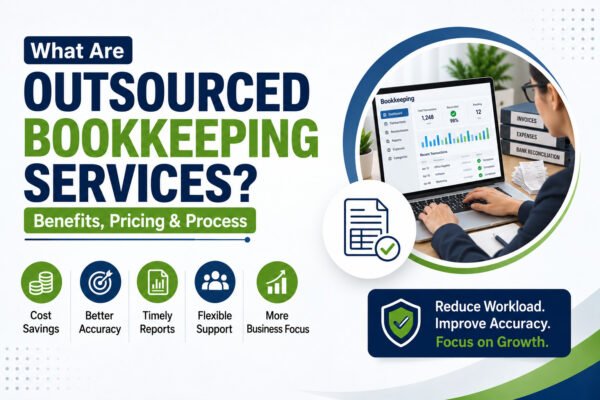
What Is an Outsourced Bookkeeping Service?
Outsourced bookkeeping refers to hiring an external bookkeeping or accounting service to handle the day-to-day financial transactions of a business. Instead of managing bookkeeping internally, businesses outsource to professionals who manage the recording of transactions, accounts reconciliation, and upkeep financial records while generating financial reports on a regular basis.
Depending on the business, outsourced bookkeeping could include:
- Preparing financial statements
- Classifying expenses
- Processing invoices
- Supporting payroll
- Managing accounts receivable (AR) and accounts payable (AP)
- Reconciling bank and credit card accounts
- Recording purchase and sales transactions
- Support for financial statement preparation
- Year-end audit and tax documentation support
Most modern bookkeeping is now done remotely through internet-based accounting programs. Professional bookkeepers utilize softwares like QuickBooks, Xero, Zoho Books, NetSuite, Tally, and other programs, enabling businesses anywhere to access their financial data in real time through secure connections.
While outsourcing bookkeeping does cut down on administrative processes, it does provide more accurate financial records and more consistent financial reporting. It also helps a business gain access to financial records more promptly, allowing for better business decisions.
Why Should Businesses Consider Outsourcing Their Bookkeeping?
As a business grows, the workload for bookkeeping grows as well. Business expansion means more customers and vendors, more invoices, and more financial transactions. All of this might make it difficult for employees to properly keep track of important business records on a day-to-day basis while performing the other required business functions.
Bookkeeping is commonly outsourced when:
- Financial employees have too many bookkeeping tasks.
- Financial records are kept by the owner instead of the owner focusing on business development.
- Full-time bookkeepers cannot be hired due to financial reasons.
- Financial reports are late or incorrect.
- Reconciliation of bank accounts is rarely done.
- Vendor and customer balances are not kept current.
- Management has no insight into financial data.
- Financial records are closed for the month in a timely manner.
But with outsourced bookkeeping businesses gain access to the benefits of accurate record keeping and timely financial reporting without the additional cost of having to recruit and train additional staff.
Advantages of Outsourcing Bookkeeping Services
Saves Time for Business Owners
As the owner of a business, time often becomes a luxury for many. Outsourcing your business’s bookkeeping operations frees up valuable time that can be put into bettering the company. Other office functions can be a heavy distraction from the day-to-day running of things and having your bookkeeping in-house can lead to a conflict of interests. All of these time-wasters and distractions need to go because as they say – out of sight, out of mind.
Reduces Hiring and Training Costs
Building an internal bookkeeping department involves more than hiring an employee. Businesses must also invest in recruitment, onboarding, salaries, employee benefits, ongoing training, accounting software, and managerial oversight.
Outsourcing eliminates many of these expenses by providing access to experienced bookkeeping professionals who already possess the necessary expertise and technology. This makes outsourcing a cost-effective option, particularly for small and medium-sized businesses.
Improves Accuracy of Financial Records
Financial records form the basis of important business decisions. Even small bookkeeping errors can affect budgeting, tax reporting, financial statements, and cash flow management.
Professional bookkeeping providers follow standardized procedures for transaction recording, account reconciliation, and financial review. Regular reconciliations help identify discrepancies before time, reducing the likelihood of duplicate entries, incorrect expense classifications, and missing transactions.
Accurate bookkeeping contributes to reliable financial reporting and stronger internal financial control.
Gives Better Financial Visibility
The bottom line is that by outsourcing your bookkeeping operations, you save money on paying full-time or part-time wages and benefits to an employee. Further, you also cut down on lost productivity costs that come along with hiring employees onto the payroll. By outsourcing your bookkeeping, you only pay for what you need, nothing more or less.
Supports Timely Reporting
Outsourcing gives you a great way to have full-time knowledge on your team without having to pay for it around the clock. By putting your books into the hands of a professionally skilled staff who understand the best practices and how to properly work for certain tasks, your job becomes a whole lot easier, and effective.
Helps With Compliance and Audit Readiness
Well-maintained financial records simplify tax filing, statutory compliance, and audit preparation.
Proper bookkeeping ensures that invoices, payment records, bank reconciliations, expense documentation, and supporting financial records remain organized throughout the year. As a result, businesses can respond more efficiently to audit requests and regulatory requirements while reducing the risk of missing important documentation.
Scales With Business Growth
Finally, outsourcing your bookkeeping allows you to expand or cut back in the blink of an eye. Whether you’re looking to grow your business or cut down on spending, having a reliable team at your behest, providing you with different plans and options will help you achieve your goals. Outsourcing provides you with the flexibility that in-house bookkeepers just can’t provide.
How Much Do Bookkeeping Services Cost?
The cost of outsourced bookkeeping varies from one business to another, depending on financial requirements. Pricing is generally determined by the complexity of bookkeeping activities rather than a single fixed rate.
Several factors influence bookkeeping service costs, including:
- Number of monthly financial transactions
- Number of bank and credit card accounts
- Number of business entities or branches
- Volume of accounts payable and accounts receivable
- Payroll processing requirements
- Frequency of bank reconciliations
- Monthly reporting requirements
- Catch-up bookkeeping for overdue records
- Accounting software integration and management
Bookkeeping providers typically offer different pricing models based on business needs.
Monthly Fixed Fee
A fixed monthly fee is one of the most common pricing models. Businesses pay a predetermined amount each month for agreed bookkeeping services, making budgeting easier.
Hourly Pricing
Some providers charge based on the number of hours spent on bookkeeping activities. This model is often suitable for businesses with fluctuating bookkeeping requirements.
Transaction-Based Pricing
Businesses with predictable transaction volumes may choose pricing based on the number of monthly financial transactions processed.
Custom Pricing
Larger organizations or businesses requiring multiple services such as bookkeeping, accounts payable, accounts receivable, payroll support, management reporting, and reconciliations often receive customized pricing based on the overall scope of work.
Simple bookkeeping requirements generally cost less, while businesses with higher transaction volumes, multiple entities, payroll processing, and comprehensive reporting requirements typically require more extensive bookkeeping support.
How to Outsource Your Bookkeeping: Practical Steps
Step 1: Review Your Current Bookkeeping Process
Begin by evaluating your existing bookkeeping process.
Ask yourself:
- Are financial records updated regularly?
- Are bank reconciliations pending?
- Are reports delayed?
- Are bookkeeping errors becoming more frequent?
Understanding current challenges helps define outsourcing requirements more effectively.
Step 2: Decide the Scope of Work
Clearly identify which bookkeeping activities you want to outsource.
These may include:
- Daily transaction entries
- Bank reconciliation
- Invoice processing
- Accounts payable
- Accounts receivable
- Payroll support
- Monthly financial reporting
Defining responsibilities early helps establish clear expectations between both parties.
Step 3: Choose the Right Outsourcing Partner
Selecting the right bookkeeping partner is one of the most important decisions.
Look for a provider with:
- Strong bookkeeping and accounting experience
- Expertise in accounting software
- Structured bookkeeping processes
- Secure data management practices
- Transparent communication
- Consistent reporting procedures
An experienced partner should understand both accounting principles and your business requirements.
Step 4: Share Access and Documents Securely
After selecting a bookkeeping partner, provide access to the required financial information using secure methods.
This may include:
- Accounting software access
- Bank statements
- Sales invoices
- Purchase invoices
- Vendor information
- Customer records
- Previous financial reports
Maintaining secure document sharing and controlled system access helps protect sensitive financial information.
Step 5: Set Reporting Timelines
Agree on how frequently financial updates should be provided.
Businesses should establish:
- Weekly or monthly reporting schedules
- Bank reconciliation timelines
- Financial report formats
- Regular review meetings
- Communication channels
Clear reporting expectations help maintain consistency throughout the engagement.
Step 6: Review Work Regularly
Although bookkeeping responsibilities are outsourced, business owners should continue reviewing financial reports on a regular basis.
Periodic reviews help verify accuracy, address questions promptly, and maintain appropriate oversight of financial operations. Major financial decisions and payment approvals should always remain under the business’s control.
Conclusion
Bookkeeping is the backbone to making sound business decisions and preserving the stability of finances. But the need to manage bookkeeping is more difficult to do in-house as the business grows.
A good outsourced bookkeeping service is the answer to this. They save the business time and money, and improve financial recordkeeping and reporting. Professional bookkeepers review and record daily bookkeeping allowing the business to focus on the big picture.
A2R Info Solutions has developed efficient and effective bookkeeping solutions that include the management of daily account reconciliations, accounts payable and receivable, and periodic financial reports and monthly accounting. Aside from providing supportive finance back office functions, we strive to increase our clients’ finance efficiencies and help them keep accurate financial records.
If you find that you are getting periodic financial reports later than you need them, have failed reconciliations, and are finding bookkeeping work more stressful and tedious, this is a good sign that you need to consider some outside bookkeeping options that will help support your business during this time of growth.